
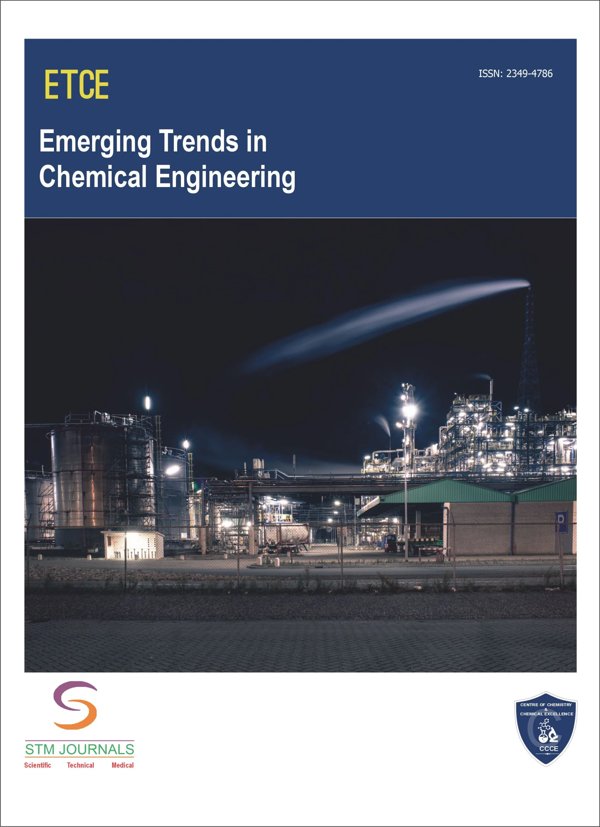
Emerging Trends in Chemical Engineering
Chemical Engineering ISSN 2349-4786 3 issues a year Hybrid open accessWhat does hybrid open access mean? This journal has two kinds of articles. Open access articles are free for anyone to read; the author pays an article processing charge for that. All other articles are for subscribers. Authors can also publish at no cost under the subscription-based option.
Submit a manuscript SubscribeRequest for my libraryEarlier years Calculate APC Search this journal Editorial board (10)
About the journal
Emerging Trends in Chemical Engineering is a peer-reviewed open-access journal of engineering and scientific journals launched in 2014 which invites contributions of novel fundamental research in the field of Chemical engineering. The journal publishes original research articles and rapid communications covering all areas of Chemical Engineering.
Journal metrics
Counted from this archive, not supplied by anyone.
- 206Articles published
- 17Published in 2026
- 437Authors
- 3Open access
Journal information
- Title
- Emerging Trends in Chemical Engineering
- Issues per year
- 3 issues
- ISSN
- 2349-4786
- Publisher
- STM Journals
- DOI
- 10.37591/ETCE
- Starting year
- 2014
- Subject
- Chemical Engineering
- Publication format
- Hybrid open access
- Language
- English
- Copyright policy
- CC BY-NC-ND 4.0
- Type
- Peer-reviewed journal (refereed)
- Article processing charge
- ₹10,000 in India · $400 outside India
- Subscription-based publication
- No cost. Author copy, DOI and certificate are chargeable.
Indexed in
Editorial board
-
Editor-in-Chief
School of Engineering and Provost-Incharge, Plastindia International University, Vapi, India
-
Associate Editor-in-Chief
Department of Biotechnology, Anna University, India
-
Associate Editor-in-Chief
Dr. Susarla Venkata Ananta Rama Sastry
Chemical Engineering, MVGR College Of Engineering,Vizianagaram, India
Latest articles
-
Digital Transformation in Chemical Engineering: A Comprehensive Review
Abstract: Digital transformation has emerged as a transformative paradigm in chemical engineering, fundamentally redefining process design, operation, optimization, and sustainability through the integration of advanced digital technologies. The convergence of Artificial Intelligence (AI), Machine Learning (ML), Industrial Internet of Things (IIoT), Digital Twins, Big Data Analytics, Cloud Computing, Cyber-Physical Systems (CPS), robotics, and advanced process automation has accelerated the transition from conventional manufacturing to intelligent, data-driven, and autonomous chemical production. These …
Published in Emerging Trends in Chemical Engineering · pp. 21–43 Read article
-
Activated Carbon-Based Adsorptive Desulphurization of Diesel for Ultra-Low Refractory Sulfur Fuel Production
Abstract: The problem of “Diesel desulphurization” needs no introduction. A successful attempt has been made to develop an adsorptive desulphurization process based on activated carbon materials as low cost, environmentally friendly and selective adsorbents for the highly stiff-necked Sulphur containing refractory molecules, namely, the dialkyl dibenxothiophenes (DADBT), especially, the 4, 6 dimethyl dibenzothiophene (4, 6 DMDBT). Removal of such refractory compounds is a major bottle-neck in the classical refinery operation, namely, …
Published in Emerging Trends in Chemical Engineering · pp. 44–54 Read article
-
Artificial Intelligence–Assisted Reduced-Order Modeling and Stability Control in
Granular Couette Flow
Abstract: This study develops a reduced-order and stability-aware modeling framework for dense granular Couette flow by integrating continuum mechanics, bifurcation analysis, and data-driven stability estimation. Starting from coupled governing equations for momentum, granular temperature, and microstructural evolution, the system is nondimensionalized and reduced using a Galerkin projection consistent with shear-driven boundary conditions. This yields a low-dimensional nonlinear dynamical system that preserves the essential coupling between velocity, fluctuation energy, and structural relaxation. …
Published in Emerging Trends in Chemical Engineering · Vol. 13, Issue 3, 2026 · pp. 44–61 Read article
-
Co-Digestion of Sewage Sludge and Food Waste for Enhanced Bio-fertilizer Production
Abstract: This study investigated the production and effectiveness of liquid and solid biofertilizers derived from co-digested water treatment plant sludge and food waste, with the aim of enhancing soil fertility and plant growth while ensuring microbiological safety. Biofertilizer samples were formulated at three concentrations (100%, 75%, and 50% sludge-based mixtures) and evaluated for physicochemical quality, microbial composition, and agronomic performance on test crops. The microbial assessment of liquid formulations revealed total …
Published in Emerging Trends in Chemical Engineering · Vol. 13, Issue 3, 2026 · pp. 1–11 Read article
-
An Extensive Analysis of CO₂ Capture Technologies and Advanced Sorbent Materials: Advances, Difficulties, and Prospects for The Future
Abstract: Since industrialization, anthropogenic carbon dioxide (CO₂) emissions have significantly grown, resulting in serious environmental effects such ice loss, ocean acidification, climate change, and ecosystem disturbance. Carbon capture and storage (CCS) technologies are therefore crucial to reaching global decarbonization targets, especially for difficult-to-abate industrial sectors. A thorough overview of CO₂ capture pathways, including post-combustion, pre-combustion, and oxy-fuel combustion processes, is provided in this paper. Additionally, the performance and application of the …
Published in Emerging Trends in Chemical Engineering · Vol. 13, Issue 3, 2026 · pp. 12–20 Read article
-
Artificial Intelligence–Assisted Reduced-Order Modeling and Stability Control in Granular Couette Flow
Abstract: This study develops a reduced-order and stability-aware modeling framework for dense granular Couette flow by integrating continuum mechanics, bifurcation analysis, and data-driven stability estimation. Starting from coupled governing equations for momentum, granular temperature, and microstructural evolution, the system is nondimensionalized and reduced using a Galerkin projection consistent with shear-driven boundary conditions. This yields a low-dimensional nonlinear dynamical system that preserves the essential coupling between velocity, fluctuation energy, and structural relaxation. …
Published in Emerging Trends in Chemical Engineering · Vol. 13, Issue 3, 2026 Read article
-
Framework-Based Optimization of Catalysis Efficiency through Reaction Pathway Engineering
Abstract: The rational design of heterogeneous catalysts through framework-based approaches has emerged as a transformative strategy for controlling reaction pathways and enhancing catalytic efficiency. This paper examines recent advances in the optimization of catalytic performance through engineered frameworks, including metal-organic frameworks (MOFs), zeolites, and related porous materials. By integrating computational methods with experimental validation, researchers have achieved unprecedented control overactive site architecture, reactant confinement, and elementary reaction steps. This work reviews …
Published in Emerging Trends in Chemical Engineering · Vol. 13, Issue 2, 2026 · pp. 88–99 Read article
-
Monitoring Total Petroleum Hydrocarbon Degradation with Influence of Grape Leaf Application as Nutrient Stimulant in Soil
Abstract: The application of the grape leaf in the treatment of petroleum hydrocarbon degradation in soil environment in investigated and the findings outline with respect to the performance of the bio-stimulant available nutrients associated with. The research reveals increase in TPH degradation in each bioreactor sampled with the room and sun-dried bio-stimulant application in the system with increase in the period of contact time. The rates in which the TPH decreases …
Published in Emerging Trends in Chemical Engineering · Vol. 13, Issue 2, 2026 · pp. 22–31 Read article
Ahead of print
Accepted and online before they are assigned to an issue.
-
Digital Transformation in Chemical Engineering: A Comprehensive Review
Abstract: Digital transformation has emerged as a transformative paradigm in chemical engineering, fundamentally redefining process design, operation, optimization, and sustainability through the integration of advanced digital technologies. The convergence of Artificial Intelligence (AI), Machine Learning (ML), Industrial Internet of Things (IIoT), Digital Twins, Big Data Analytics, Cloud Computing, Cyber-Physical Systems (CPS), robotics, and advanced process automation has accelerated the transition from conventional manufacturing to intelligent, data-driven, and autonomous chemical production. These …
Published in Emerging Trends in Chemical Engineering · pp. 21–43 Read article
-
Activated Carbon-Based Adsorptive Desulphurization of Diesel for Ultra-Low Refractory Sulfur Fuel Production
Abstract: The problem of “Diesel desulphurization” needs no introduction. A successful attempt has been made to develop an adsorptive desulphurization process based on activated carbon materials as low cost, environmentally friendly and selective adsorbents for the highly stiff-necked Sulphur containing refractory molecules, namely, the dialkyl dibenxothiophenes (DADBT), especially, the 4, 6 dimethyl dibenzothiophene (4, 6 DMDBT). Removal of such refractory compounds is a major bottle-neck in the classical refinery operation, namely, …
Published in Emerging Trends in Chemical Engineering · pp. 44–54 Read article