
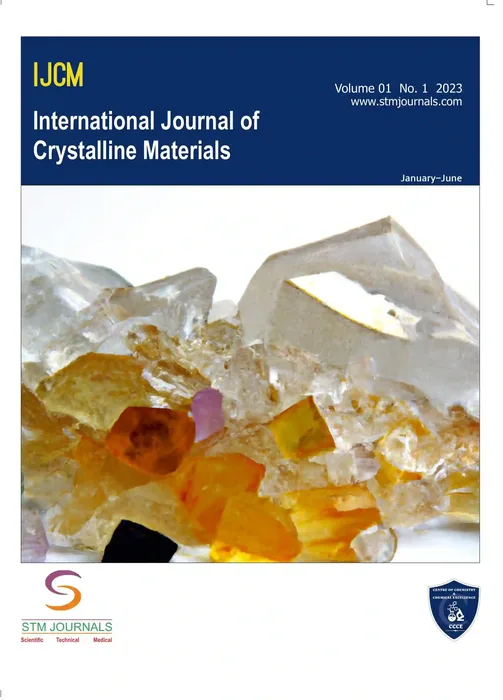
International Journal of Crystalline Materials
Chemistry ISSN 3107-877X 2 issues a year Hybrid open access
About the journal
International Journal of Crystalline Materials is a peer-reviewed online journal launched in 2024 that aims to provide a platform for researchers and scientists to share their latest findings and developments in the field of crystalline materials. The journal focuses on research related to the fundamental properties and applications of crystalline materials, including their synthesis, characterization, structure, properties, and performance.
Journal metrics
Counted from this archive, not supplied by anyone.
- 25Articles published
- 5Published in 2026
- 44Authors
- 0Open access
Journal information
- Title
- International Journal of Crystalline Materials
- Issues per year
- 2 issues
- ISSN
- 3107-877X
- Publisher
- STM Journals
- Starting year
- 2024
- Subject
- Chemistry
- Publication format
- Hybrid open access
- Language
- English
- Type
- Peer-reviewed journal (refereed)
Editorial board
-
Editor-in-Chief
Chemistry, Mahatma Gandhi University, India
Latest articles
-
Total-internal-reflection-based optical rotation quasi-phase-matching for efficient second-harmonic generation in Cadmium Germanium Arsenide crystal
Abstract: This study investigates a total-internal-reflection (TIR)-based optical rotation quasi-phase-matching (ORQPM) approach for second harmonic generation within a cadmium germanium arsenide crystal slab. The crystal is coated with a thin film of yttrium oxide to facilitate precise control over phase shifts between p- and s-polarized light upon reflection at the slab-film interface. By leveraging the interplay between TIR- induced optical rotation and fractional QPM effects at designated bounce points, the configuration …
Published in International Journal of Crystalline Materials · Vol. 3, Issue 1, 2026 Read article
-
Crystal Defects and Their Characterization in Modern Materials Science
Abstract: The physical and chemical properties of crystalline solids are fundamentally dictated by deviations from structural perfection, known as crystal defects. From the point-scale vacancies that drive diffusion to the planar boundaries that determine mechanical strength, defects serve as the primary "tuning knobs" in material design. This review provides a comprehensive examination of point, line, and planar defects, exploring their formation energetics and their role in plastic deformation via crystallographic slip. …
Published in International Journal of Crystalline Materials · Vol. 3, Issue 1, 2026 · pp. 15–19 Read article
-
Solid-State Reactions: Mechanistic Insights, Kinetic Behavior and Emerging Applications in Advanced Materials
Abstract: Solid-state reactions are fundamental to the synthesis and transformation of inorganic materials, playing a crucial role in the development of ceramics, semiconductors, catalysts, and energy storage systems. Unlike reactions in liquid or gaseous phases, they are limited by restricted atomic mobility and typically require elevated temperatures to enhance diffusion and overcome activation energy barriers. These reactions proceed through interfacial contact between solid reactants, followed by nucleation of product phases and …
Published in International Journal of Crystalline Materials · Vol. 3, Issue 1, 2026 · pp. 10–14 Read article
-
Comprehensive Review of the Fundamental and Functional Properties of Crystalline Materials
Abstract: Crystalline materials, characterized by their highly ordered atomic arrangements, serve as the backbone of modern engineering and technology. This review provides a detailed examination of their diverse properties, categorized into mechanical, thermal, electrical, and optical domains. We analyze fundamental mechanical parameters such as the elastic modulus, yield strength, and fracture toughness, alongside functional behaviors like fatigue and creep. The discussion extends to thermal transport and expansion, electrical conductivity and resistivity, …
Published in International Journal of Crystalline Materials · Vol. 3, Issue 1, 2026 · pp. 20–24 Read article
-
Minerals: A Comprehensive Review of Classification, Properties, Formation, and Their Role in Modern Technology and Sustainability
Abstract: Minerals are naturally occurring, inorganic, solid elements with a definite chemical composition and a characteristic crystal structure. They are the building blocks of rocks. Minerals are the key to the development and progress of human civilization. They are used for the development of infrastructure, electronic gadgets, agriculture, and medicine. This research paper aims to present an exhaustive overview on the field of mineralogy, which includes the definition, classification, physical and …
Published in International Journal of Crystalline Materials · Vol. 3, Issue 1, 2026 · pp. 25–33 Read article
-
Microstructural Design and Functional Properties of Polycrystalline Materials
Abstract: Polycrystalline materials, composed of an aggregate of crystallites or grains, are foundational to modern engineering applications due to their versatile functional properties. The microstructural design—encompassing grain size, shape, orientation, phase distribution, and grain boundary characteristics—plays a pivotal role in determining mechanical, thermal, electrical, and magnetic behavior. This abstract explores the intricate relationship between microstructure and functionality, emphasizing how tailored processing techniques such as thermomechanical treatments, sintering, and additive manufacturing can …
Published in International Journal of Crystalline Materials · Vol. 2, Issue 2, 2025 · pp. 16–20 Read article
-
The Effect of Rare Earth (RE) Metal Doping of Zno, On Magnetic and Optical Properties of Zno Crystals Structure
Abstract: The magnetic and optical properties of magnetic semiconductors relays on the crystal structure, type and amount of dopant ions, and particle size. Then, the effect of rare earth metal (Dy, Eu, and La) doping on crystal structures, magnetic properties and optical properties are seen. It is revealed that the optical band gap of ZnO decrease down from 3.37eV up on doping with RE metals. Then, the Hamiltonian of the system …
Published in International Journal of Crystalline Materials · Vol. 2, Issue 2, 2025 · pp. 28–40 Read article
-
Flaws and Defects in Crystals
Abstract: Crystalline materials are defined by their long-range atomic order; however, no real crystal is completely free from imperfections. This article provides a comprehensive overview of the various types of crystal defects and imperfections that occur in solid materials and their significant influence on material properties. Point defects, including vacancies, interstitials, and substitutional atoms, are examined alongside line defects such as edge and screw dislocations, as well as planar defects encompassing …
Published in International Journal of Crystalline Materials · Vol. 2, Issue 2, 2025 · pp. 1–15 Read article
Archive on its own page →
Volume 3 (2026) 5 articles
- Issue 1 5 articles