
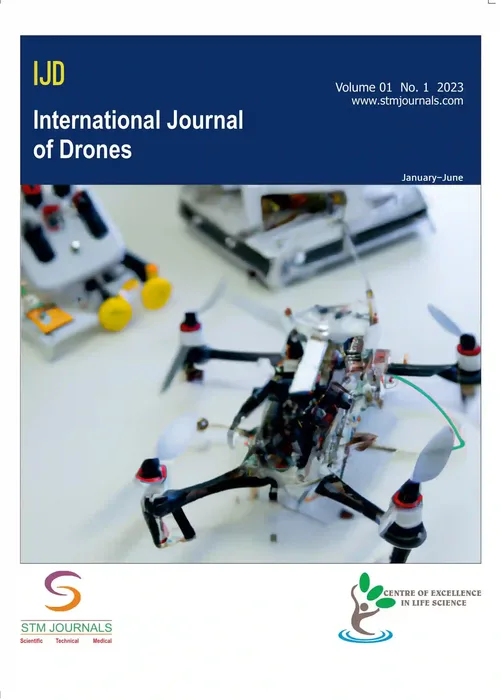
International Journal on Drones
Multidisciplinary 2 issues a year Hybrid open accessWhat does hybrid open access mean? This journal has two kinds of articles. Open access articles are free for anyone to read; the author pays an article processing charge for that. All other articles are for subscribers. Authors can also publish at no cost under the subscription-based option.
Submit a manuscript SubscribeRequest for my libraryEarlier years Calculate APC Search this journal Editorial board (6)
About the journal
International Journal on Drones is a peer-reviewed Online journal launched in 2025 that focuses on the latest developments, research, and applications related to drones and unmanned aerial vehicles (UAVs). The journal aims to provide a platform for researchers, engineers, practitioners, and students to publish high-quality papers on topics related to drones. The scope of the journal includes both theoretical and practical aspects of drone technology.
Journal metrics
Counted from this archive, not supplied by anyone.
- 19Articles published
- 9Published in 2026
- 41Authors
- 0Open access
Journal information
- Title
- International Journal on Drones
- Issues per year
- 2 issues
- P-ISSN
- null
- Publisher
- STM Journals
- DOI
- 10.37591/IJD
- Starting year
- 2025
- Subject
- Multidisciplinary
- Publication format
- Hybrid open access
- Language
- English
- Copyright policy
- CC BY-NC-ND 4.0
- Type
- Peer-reviewed journal (refereed)
- Article processing charge
- ₹10,000 in India · $400 outside India
- Subscription-based publication
- No cost. Author copy, DOI and certificate are chargeable.
Editorial board
-
Editor-in-Chief
Electronics and Communication, ITM University Gwalior, India
-
Associate Editor-in-Chief
Electrical Department, International school of Technology and Sciences for Women, India
Latest articles
-
JATAYU: A Stereo Vision–Based UAV for Autonomous Navigation and Human Following in GPS-Denied Environments
Abstract: Traditional unmanned aerial vehicle (UAV) systems primarily rely on Global Positioning System (GPS)-based navigation and conventional computer vision techniques. However, these approaches face significant challenges in GPS-denied environments, such as dense urban areas, indoor spaces, and disaster-affected regions where GPS signals may be weak, unavailable, or unreliable. In addition, limitations in real-time processing, object detection accuracy, and environmental perception can reduce UAV effectiveness in dynamic and unpredictable situations. This paper …
Published in International Journal on Drones · Vol. 2, Issue 2, 2026 · pp. 30–38 Read article
-
Wildfire Detection and Tracking System
Abstract: To create a precise forecast of the wildfire, it is crucial to possess the capability to recognize it and anticipate how it will distribute. The devastation of vegetation, the loss of assets, the rise in greenhouse gases, the extinction of Numerous animal species and even human fatalities can all result from wildfires. To trim back this danger, there must be a mechanism capable of detecting a fire the moment it …
Published in International Journal on Drones · Vol. 2, Issue 2, 2026 · pp. 21–29 Read article
-
Artificial Intelligence in Autonomous Military Weaponry Systems
Abstract: The rapid rise of artificial intelligence (AI) has transformed contemporary defence organizations, reshaping military structures, operational strategies, and the design and deployment of modern weapons. AI has significantly influenced the architecture, decision-making processes, and functionality of military systems, particularly in complex and rapidly evolving combat scenarios. This paper provides a comprehensive analysis of the growing use of autonomous military weapon systems, focusing on technological developments, regulatory challenges, governance gaps, and …
Published in International Journal on Drones · Vol. 2, Issue 2, 2026 · pp. 09–20 Read article
-
Adaptive Robust Constraint-Based Nonlinear Control for Trajectory Tracking and Dynamic Obstacle Avoidance in Multi-copter UAVs
Abstract: An adaptive robust nonlinear control system for multi-copter unmanned aerial vehicles (UAVs) trajectory tracking and obstacle avoidance is presented in this research. The suggested approach addresses nonlinear dynamics and environmental uncertainties by combining adaptive disturbance estimates with constraint-based control. Nonlinear differential equations are used to simulate the motion of the UAV, with obstacle avoidance represented as an inequality constraint and trajectory tracking as an equality constraint. The Udwadia–Kalaba method is …
Published in International Journal on Drones · Vol. 2, Issue 2, 2026 · pp. 01–08 Read article
-
Trends, Challenges, and the Future of Unmanned Aerial Systems
Abstract: The rapid evolution of unmanned aerial vehicles (UAVs), commonly referred to as drones, has transformed numerous domains — from military surveillance and logistics to precision agriculture and atmospheric research. This paper examines the current state of drone technology, industry trends, regulatory frameworks, socio-economic impacts, ethical considerations, and future research directions. With contributions from multidisciplinary studies, this review emphasizes emerging technologies, performance metrics, risk factors, and opportunities for innovation. In recent …
Published in International Journal on Drones · Vol. 2, Issue 1, 2026 · pp. 27–33 Read article
-
The Future of Farming with IoT-Operated Drones
Abstract: The integration of Internet of Things (IoT) technology with drone systems has revolutionized precision agriculture, offering innovative solutions to address the inefficiencies and environmental concerns linked to conventional pesticide application. This study explores the design, implementation, and impact of IoT-operated drones tailored for automated pesticide spraying. By leveraging real-time sensor data, AI-driven analytics, and cloud-based connectivity, these drones enable dynamic, data-informed decisions to optimize chemical application. Results indicate that IoT-enabled …
Published in International Journal on Drones · Vol. 2, Issue 1, 2026 · pp. 20–26 Read article
-
Electronic Drones: Technology, Applications, and Future Directions
Abstract: Electronic drones, commonly referred to as Unmanned Aerial Vehicles (UAVs), have transitioned from exclusively military platforms to indispensable tools across commercial, scientific, industrial, and recreational domains. The rapid evolution of electronics, flight control systems, communication networks, onboard sensors, and artificial intelligence has reshaped drone capabilities, enabling high-precision remote sensing, autonomous navigation, swarm behavior, and integration into complex systems like the Internet of Drones (IoD). This paper examines the technological building …
Published in International Journal on Drones · Vol. 2, Issue 1, 2026 · pp. 15–19 Read article
-
Optimization of Pesticide Requirement Calculations for IoT-Operated Hexacopter Delivery Systems
Abstract: The integration of Internet of Things (IoT) technology into precision agriculture has transformed pesticide application strategies, enabling resource-efficient and environmentally sustainable practices. This study presents a computational methodology for optimizing pesticide requirements in an IoT-operated hexacopter system, designed for dynamic, data-driven pesticide delivery. Leveraging a fusion of real-time telemetric data from onboard LiDAR, multispectral imaging sensors, and environmental monitoring modules, the system employs predictive analytics and edge computing to calculate …
Published in International Journal on Drones · Vol. 2, Issue 1, 2026 · pp. 08–14 Read article