
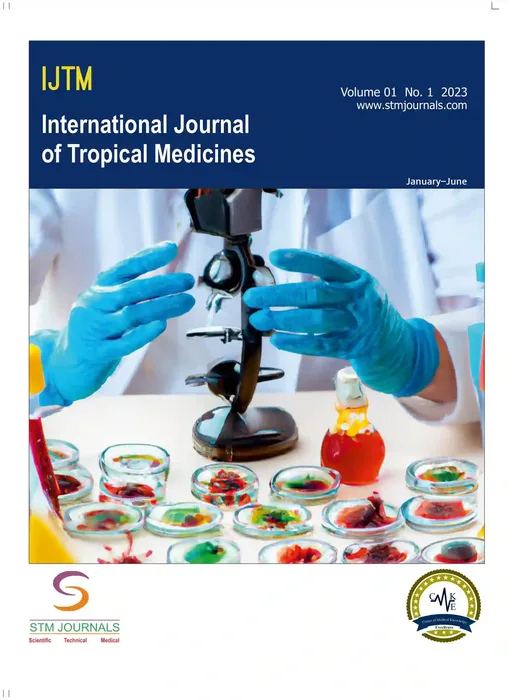
International Journal of Tropical Medicines
Medical Sciences ISSN 3048-6262 2 issues a year Hybrid open accessWhat does hybrid open access mean? This journal has two kinds of articles. Open access articles are free for anyone to read; the author pays an article processing charge for that. All other articles are for subscribers. Authors can also publish at no cost under the subscription-based option.
Submit a manuscript SubscribeRequest for my libraryEarlier years Calculate APC Search this journal Editorial board (9)
About the journal
International Journal of Tropical Medicines is a peer-reviewed open-access journal launched in 2024 that focuses on research and advancements in the field of tropical medicine. The journal aims to publish high-quality, original research papers, review articles, and case reports on all aspects of tropical medicine. The scope of the journal also includes interdisciplinary research that bridges the gap between basic science and clinical research in tropical medicine, as well as research on the social, economic, and environmental determinants of tropical diseases.
Journal metrics
Counted from this archive, not supplied by anyone.
- 34Articles published
- 8Published in 2026
- 121Authors
- 1Open access
Journal information
- Title
- International Journal of Tropical Medicines
- Issues per year
- 2 issues
- ISSN
- 3048-6262
- Publisher
- STM Journals
- Starting year
- 2024
- Subject
- Medical Sciences
- Publication format
- Hybrid open access
- Language
- English
- Copyright policy
- CC BY-NC-ND 4.0
- Type
- Peer-reviewed journal (refereed)
- Article processing charge
- ₹10,000 in India · $400 outside India
- Subscription-based publication
- No cost. Author copy, DOI and certificate are chargeable.
Editorial board
-
Editor-in-Chief
Pharmacy, Mansarovar Global University, India
-
Associate Editor-in-Chief
Prof. Dr. Mirza R. BAIG
Department of Pharmacy, Dubai Pharmacy College for Girls, Dubai
Latest articles
-
Why Ebola Continues to Re-Emerge: Systemic Failures, Emerging Challenges, and Innovative Strategies for Sustainable Prevention and Control
Abstract: Background: The rapid surge in the Ebola Virus Disease (EVD) seems to have overwhelmed a seemingly resilient healthcare system, especially in countries that have recorded high numbers of infections in recent times. There is no doubt that there have been advances in diagnostics, improved vaccines, therapeutics, and better outbreak response, yet recurrent outbreaks of the virus persist. What could be wrong? With this pattern, it will not be far-fetched to …
Published in International Journal of Tropical Medicines Read article
-
Reward-Aligned Reinforcement Learning from Human Feedback for Emotion-Sensitive Large Language Model Therapists: Balancing Empathetic Engagement, Boundary Safety, and Clinical Accountability
Abstract: The deployment of large language models (LLMs) in mental health therapy contexts introduces a critical alignment challenge: these systems must simultaneously cultivate genuine empathic rapport, observe clinically grounded safety boundaries, and remain auditable under institutional accountability frameworks. Existing reinforcement learning from human feedback (RLHF) pipelines optimize for a scalar reward signal that is demonstrably insufficient for the multi-objective, temporally extended nature of therapeutic conversation. This paper presents RA-RLHF-T (Reward-Aligned RLHF …
Published in International Journal of Tropical Medicines · Vol. 3, Issue 2, 2026 Read article
-
"Onychomycosis in the Indian Subcontinent: Clinical, Microbiological and Therapeutic Perspectives,”
Abstract: Onychomycosis is a chronic fungal infection of the nail unit involving the plate, bed, and matrix, accounting for a substantial proportion of nail disorders encountered in dermatology practice worldwide. In South Asia—particularly India, Pakistan, Bangladesh, and Nepal—the burden is amplified by a convergence of climatic, socioeconomic, and healthcare-related factors. Hot and humid environmental conditions, widespread dermatophytosis, occlusive footwear practices, chronic wet work, and limited access to specialized mycological diagnostics contribute …
Published in International Journal of Tropical Medicines · Vol. 3, Issue 2, 2026 Read article
-
Drug Marketing in Tropical Regions and Its Effect on Pharmacovigilance Awareness and Reporting
Abstract: Drug marketing practices in tropical regions present a complex interplay between pharmaceutical promotion, healthcare infrastructure limitations, and public health outcomes. These regions – characterized by high disease burden, socio-economic disparities, and diverse healthcare delivery systems – often experience unique challenges in ensuring safe and rational drug use. Aggressive and sometimes unregulated marketing strategies by pharmaceutical companies may significantly influence prescribing behavior, patient compliance, and, ultimately, pharmacovigilance systems. Pharmacovigilance, defined as …
Published in International Journal of Tropical Medicines · Vol. 3, Issue 2, 2026 · pp. 1–17 Read article
-
Infectious illnesses in areas of violence and among refugees
Abstract: Infectious illnesses are a huge and ongoing hazard in conflict zones and among refugee populations. This is because frail health systems, population relocation, and poor living conditions all come together to make transmission risks higher. Armed conflict undermines vital public health infrastructure, such as vaccination programs, disease surveillance, water and sanitation systems, and access to medical care, resulting in the resurgence and proliferation of avoidable and treatable illnesses. Refugee camps …
Published in International Journal of Tropical Medicines · Vol. 3, Issue 1, 2026 · pp. 36–40 Read article
-
A Systematic Review on Factors Contributing to Infertility
Abstract: Infertility is a multifactorial reproductive health condition affecting approximately 10–15% of couples worldwide and continues to represent a major clinical and social challenge. Despite substantial advances in assisted reproductive technologies, diagnostic methods, and therapeutic interventions, many couples still face difficulties in achieving pregnancy. The impact of infertility extends beyond physical health, often leading to emotional distress, social pressure, and financial burdens, especially in societies where parenthood is highly valued. Consequently, …
Published in International Journal of Tropical Medicines · Vol. 3, Issue 1, 2026 · pp. 31–35 Read article
-
Immunological Biomarkers and Epidemiological Evaluation of Lymphatic Filariasis Elimination Efforts in Osun State, Nigeria
Abstract: Lymphatic filariasis (LF) remains a neglected tropical disease affecting millions globally, despite extensive elimination efforts. While the interruption of transmission is a key goal, the long-term immunological effects on individuals with existing complications like elephantiasis remain poorly understood. This study assessed the current transmission status of LF and the haematological profiles of infected individuals across selected Local Government Areas (LGAs) in Osun State, Nigeria. A total of 7,388 individuals from …
Published in International Journal of Tropical Medicines · Vol. 3, Issue 1, 2026 · pp. 22–30 Read article
-
Nature’s Pharmacy: Plant-Based Antifungal Agents and Their Therapeutic Potential
Abstract: Antifungal resistance has increased dramatically over the last 10 years, causing serious problems for healthcare because of higher morbidity and death. The urgent need for new treatments is highlighted by the scarcity of effective antifungal medications, their toxicity, and the rise of resistant strains. Since many plants have bioactive secondary metabolites with strong antifungal qualities, including alkaloids, flavonoids, terpenoids, phenolics, and saponins, ethnobotanical sources offer a viable path. Plants with …
Published in International Journal of Tropical Medicines · Vol. 3, Issue 1, 2026 · pp. 1–7 Read article
Ahead of print
Accepted and online before they are assigned to an issue.
-
Why Ebola Continues to Re-Emerge: Systemic Failures, Emerging Challenges, and Innovative Strategies for Sustainable Prevention and Control
Abstract: Background: The rapid surge in the Ebola Virus Disease (EVD) seems to have overwhelmed a seemingly resilient healthcare system, especially in countries that have recorded high numbers of infections in recent times. There is no doubt that there have been advances in diagnostics, improved vaccines, therapeutics, and better outbreak response, yet recurrent outbreaks of the virus persist. What could be wrong? With this pattern, it will not be far-fetched to …
Published in International Journal of Tropical Medicines Read article