
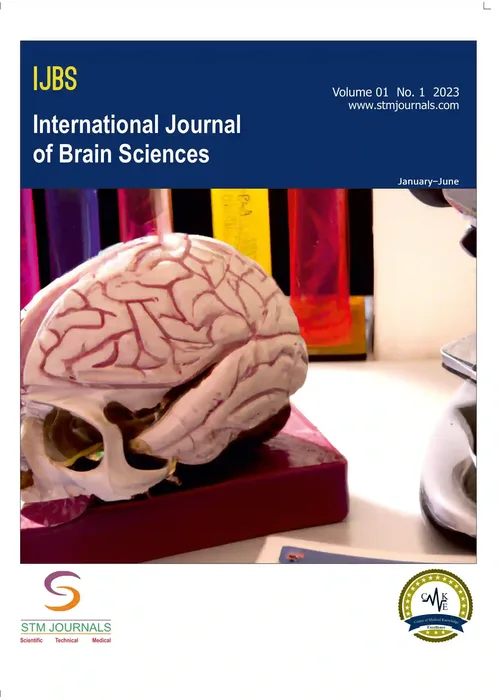
International Journal of Brain Sciences
Medical Sciences ISSN 3048-7935 2 issues a year Hybrid open access
About the journal
International Journal of Brain Sciences is a peer-reviewed online journal launched in 2024 that publishes original research articles, reviews, case reports, and short communications on all aspects of brain sciences.
Journal metrics
Counted from this archive, not supplied by anyone.
- 31Articles published
- 9Published in 2026
- 110Authors
- 0Open access
Journal information
- Title
- International Journal of Brain Sciences
- Issues per year
- 2 issues
- ISSN
- 3048-7935
- Publisher
- STM Journals
- DOI
- https://doi.org/10.37591/IJBS.v02i01.203734
- Starting year
- 2024
- Subject
- Medical Sciences
- Publication format
- Hybrid open access
- Language
- English
- Type
- Peer-reviewed journal (refereed)
Editorial board
-
Editor-in-Chief
Dr. Podolsky Illya Mykolayovych
Department of Medicinal Chemistry, National University of Pharmacy, Ukraine, Ukraine
-
Associate Editor-in-Chief
Biomedical Sciences, Gulf Medical University, United Arab Emirates
Latest articles
-
Deep Learning Based Detection and Classification of Brain Tumors Using MRI Images
Abstract: Brain tumor detection using magnetic resonance imaging (MRI) is a critical task in the early detection and treatment of brain tumors. Manual analysis of brain tumor detection using MRI is a tedious task that requires expertise in the field. Therefore, this study proposes a deep learning-based approach for brain tumor detection and classification using Convolutional Neural Networks (CNN). The proposed approach preprocesses the MRI image using normalization, resizing, and noise …
Published in International Journal of Brain Sciences · Vol. 3, Issue 2, 2026 Read article
-
Artificial Intelligence in Early Diagnosis and Personalized Treatment of Alzheimer’s Disease
Abstract: Artificial intelligence (AI) has become a disruptive technology in the medical care industry, with potential solutions to early diagnosis and customized treatment of Alzheimer’s disease (AD), a progressive neurodegenerative disease and the most prevalent cause of dementia globally. Conventional diagnostic techniques, such as cognitive, neuroimaging and biomarker techniques, are usually limited in the ability to detect disease at its most susceptible stage when treatment interventions are most effective. The recent …
Published in International Journal of Brain Sciences · Vol. 3, Issue 2, 2026 · pp. 15–27 Read article
-
AI Driven IoT Based Decision Making System for Brain wave study: KSK approach for Brain wave study
Abstract: The rapid convergence of Internet of Things (IoT) architectures and deep learning has unlocked unprecedented potential for real-time neuro-diagnostic monitoring. This paper presents a novel framework for an AI-driven IoT ecosystem designed to capture, transmit, and interpret human electroencephalography (EEG) signals with minimal latency. Traditional brain-computer interface (BCI) studies are often constrained by localized computing power and the high dimensionality of neural data. Our proposed architecture integrates low-power EEG sensors …
Published in International Journal of Brain Sciences · Vol. 3, Issue 2, 2026 Read article
-
Circadian Regulation of Lipid Peroxidation in the Brain: Linking Ferroptosis to Neurodegenerative Vulnerability
Abstract: The human brain operates through highly coordinated physiological and biochemical processes that regulate cognition, behavior, and neural adaptability. Central to these processes are mechanisms governing brain function, neurophysiology, and neuroplasticity, which are increasingly recognized to be influenced by circadian rhythms. Recent advances in cognitive neuroscience, neuroimaging, and behavioral neuroscience have revealed that disruptions in circadian regulation can significantly impact oxidative balance within the brain, particularly through enhanced lipid peroxidation. Lipid …
Published in International Journal of Brain Sciences · Vol. 3, Issue 2, 2026 · pp. 1–14 Read article
-
Plant-Derived Psychotropic Agents Targeting Neurotransmitter Systems: Pharmacognostic Evidence, Mechanisms, and Clinical Relevance
Abstract: Psychiatric health problems are also a large burden on global health and existing psychotropic drugs may be restricted by relative effectiveness, side effects, and inadequate long-term tolerability. Plant- based psychotropic agents have subsequently been the focus of interest in the form of complementary or alternative therapies. This review outlines the pharmacognostic, mechanisms of action and therapeutic importance of plant-based psychotropic agents against central neurotransmitter systems. The traditional medicinal practices give …
Published in International Journal of Brain Sciences · Vol. 3, Issue 1, 2026 · pp. 34–42 Read article
-
NeuroWell: AI-Powered Wearable & Therapy Hub for Mental Health
Abstract: Mental health problems such as anxiety, depression, PTSD and sleep disorders affect millions of people worldwide and are a major burden on health systems, with traditional treatment methods usually leading to suboptimal outcomes due to a lack of real-time monitoring, individual intervention or availability. NeuroWell is a cutting-edge artificial intelligence platform combining bio-sensing, neurostimulation and digital therapy into a single mental health support system, using state-of-the-art technologies like EEG, HRV …
Published in International Journal of Brain Sciences · Vol. 3, Issue 1, 2026 · pp. 27–33 Read article
-
Studying the effects of Exposure to Chemicals on The brain and Nervous System and The risk of Chemical Pollution
Abstract: Scientific research and studies on chemical pollution show that exposure of the brain and nervous system to chemicals causes serious damage ranging from cognitive, motor, and nerve cell disorders to chronic diseases such as Alzheimer's and neurological paralysis. These substances (such as lead ions, mercury, solvents that combine and dissolve easily in the blood, and pesticides) disrupt neurotransmitters and cause cell damage, especially during the early stages of body development. …
Published in International Journal of Brain Sciences · Vol. 3, Issue 1, 2026 Read article
-
Neuroinflammation Is Aggravated by the Aqueous Extract of Myrmecodia Platytyrea Tuber
Abstract: Myrmecodia platytyrea, commonly known as the ant plant, is a medicinal epiphyte traditionally used in Southeast Asia for its purported health benefits, including anti-inflammatory, antioxidant, antimicrobial, and anticancer activities. Its tuber contains abundant secondary metabolites, including flavonoids, tannins, phenolic compounds, and saponins. While these phytochemicals are generally associated with therapeutic effects, the biological activity of Myrmecodia extracts varies depending on the type of extract, dosage, and route of administration. In …
Published in International Journal of Brain Sciences · Vol. 3, Issue 1, 2026 · pp. 5–14 Read article